What Happens If My Solar System Stops Working?
A solar system has no moving parts, which is why it tends to run quietly for decades. But like any system made of parts, things can fail. Knowing what to look for (and what's actually your installer's job) makes the difference between a quick fix and a long headache.
Last updated 2026-08-19
First: is it a system problem or a utility outage?
If your whole home is dark, it's almost certainly a grid outage — your solar won't keep power on unless you have backup-configured equipment (see Battery Storage). If your home has power but your monitoring shows little or no production on a sunny day, that points to the system itself.
What monitoring tells you
- Total production over the day vs. expected for the season
- Per-panel output (with microinverters) — a single panel at zero points to one inverter
- Alerts for communication or hardware issues
- Historical comparison against prior months
Seasonal dips are normal
Common failures
Microinverter failure
One microinverter dies; one panel stops producing. Visible in panel-level monitoring as a single zero. The rest of the array keeps working.
Panel failure
A panel stops outputting due to internal damage or a defect. Also shows as one panel dropping in monitoring.
String inverter failure
A central inverter fault drops the entire string/ array offline at once.
Communication issue
The system works but monitoring goes offline. Often a networking problem, not an energy problem.
Troubleshooting basics
- Check your monitoring app first — it shows where the problem is.
- Confirm your home still has grid power (rule out an outage).
- Note any alerts and error codes.
- Contact your installer with that information.
Who pays for the fix: warranty vs labor
Here's the part that catches people. A failed part may be covered under a manufacturer warranty — but the labor to swap it may or may not be covered. Your installer's workmanship warranty is what determines whether the service visit is free to you. See Solar Panel Warranties Explained for that distinction.
Installer responsibility after install
Who handles service after installation matters as much as the install itself. If your installer won't be around to service the system in year 7, the warranty on paper matters less. Ask before you sign who handles service calls and for how long.
Next step
Ask Charles for the actual warranty documentation applicable to your proposed system.
Equipment names and warranty paperwork matter — get the details before you sign.
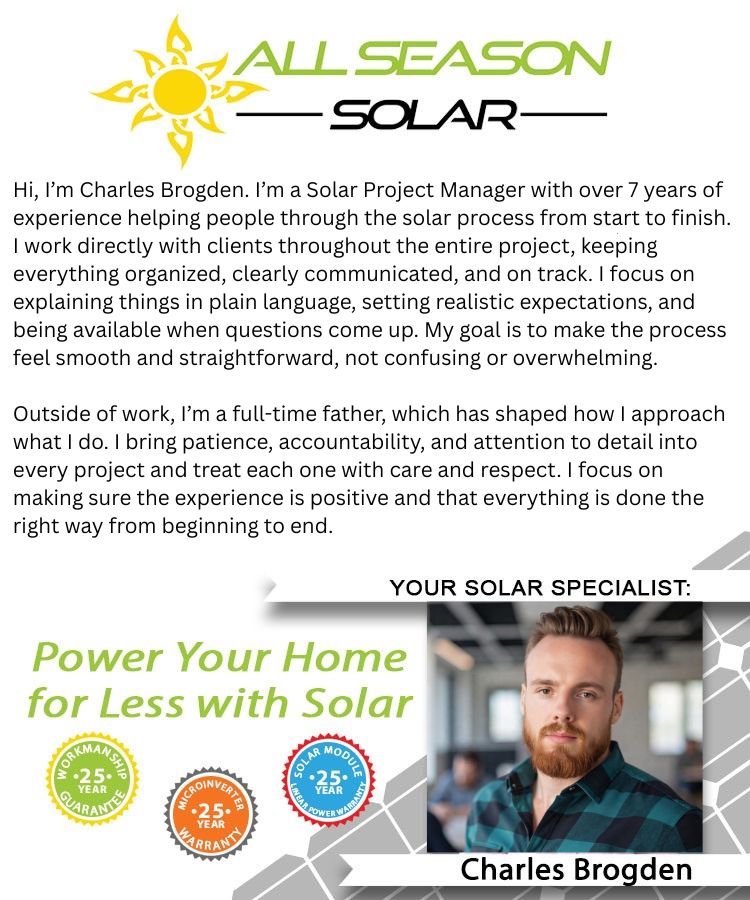
About Charles Brogden
Charles Brogden works directly with homeowners through AllSeason Solar & Roofing, helping customers understand solar system design, equipment, roofing considerations and available solar options.
Serving homeowners throughout New Jersey and Pennsylvania.